
Button Maker Kit Comparison
What is the best button maker? It is the one still pressing clean, tight buttons years from now — and the difference comes down to how the machine is built. This guide walks through what separates a machine that lasts from one that fights you, with side-by-side video, teardown photos, and the design details that matter.
American Button Machines has offered button makers made in the USA since 2005. We sell to schools, libraries, crafters, campaigns, and small businesses across the country, and every machine we sell carries a lifetime warranty against defects.
What Makes a Button Maker Worth Buying
Not all button machines are built the same way. Here is what to look for — and how ABM machines are built on each point.
- All-steel construction. Our machines are made from steel, not plastic or composite parts, yet stay light enough to carry to events and classrooms.
- A patented two-step press process. Make a button in under 5 seconds — several hundred buttons an hour once you find your rhythm.
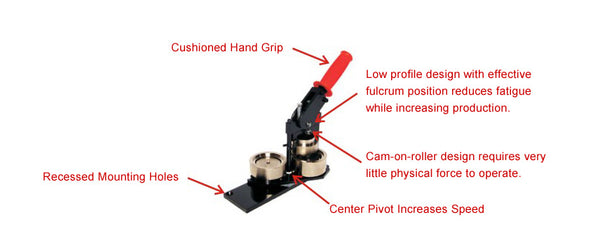
- Cam-on-roller design. Minimal physical force to operate, which is why our machines run in schools and libraries: kids can press buttons safely.
- No compression rings on the dies. Our center-pivot design uses metal dies with no compression rings to wear out, fall off, or misalign — a common failure point on other machines.
- Stable, mountable base. A low center of gravity keeps the machine from tipping, and built-in mounting holes let you secure it to a table for high-volume runs.
- A lifetime warranty against defects. Machines built to be repaired and kept, not replaced.
Watch the Difference
The clearest way to compare button makers is to watch them work. The first video shows a typical imported 3-in-1 button machine. Around the 2:40 mark, note how long it takes to seat the photo and mylar in the die properly — and how much force the press takes. The back of the machine lifts off the table.
Now watch an American Button Machines press in use — supplies load directly in front of the operator, the dies swivel on a center axis, and the press completes with an easy pull.
Design: Where the Speed Comes From
American Button Machines press:
Typical imported button machine:

On an ABM press, button supplies load directly in front of the operator. The two hardened steel, nickel-plated lower dies swivel on a center axis: load the parts, rotate each die under the upper die, pull the handle, and the button is pressed. No sliding back and forth, no re-aligning between presses. That center-pivot design is how the machine produces a button in as little as five seconds.
Slide-style machines work differently: the dies must be pushed from left to right to load supplies, then slid back again to remove the finished button and reload. Every button means extra movements — and on a long run, those movements add up. Our lower dies are securely fastened to the rotating plate so they cannot drift; the dies land aligned under the upper die every single press.
What We Found Inside an Imported 3-in-1
We purchased a typical imported 3-in-1 button machine and took it apart. Here is what we documented.
Dies Resting in Soft Aluminum

The sliding dies on the machine we examined were not fastened down. They sat in shallow holes in a light aluminum plate, held in place by gravity, with two screws acting as end stops. In the photo above you can see the result: the heavy steel dies had already worn the round alignment hole into an oblong one. Those holes are all that keep the dies aligned with the upper die — and once alignment goes, so does every button you press.
A Cast Handle Mount

Most of the pressing force in any button machine transfers where the handle meets the body. On the machine we opened up, the handle threaded into a cast aluminum fitting rather than solid steel. Castings are made by pouring liquid metal into a mold — an inexpensive process that is not as strong as machined steel, and the soft threads can strip if the handle is ever screwed in at an angle. When that part fails on an imported machine, finding a replacement is the next problem.
A Frame That Is Not What It Looks Like
The machine appeared to be all steel. It was not: an internal metal frame was covered in thick molded plastic, then painted. The tall tower shape also put the weight up high — the base plate was plastic, and pulling the handle lifted the back of the machine off the table. A press should not need to be wrestled.
The Real Cost of a Button Machine
The price on the listing is not the whole cost of owning a button maker. Import machines can end up costing more than their purchase price over time, for three reasons:
- Repurchasing the machine itself. Plastic components, sliding dies, and replaceable dies tend to be the largest failure points on import machines — and when one of those fails, many owners end up buying a whole new machine rather than repairing the one they have.
- Finding supplies for it later. Import machine providers change frequently, and when the seller you bought from disappears, matching shells, mylar, and backs to your machine gets challenging. ABM stocks the full supply lineup for every machine we sell, year after year.
- Wasted graphics and ruined art. An inconsistent press produces more failed buttons — and every failed button takes a printed graphic with it. If you are pressing one-of-a-kind artwork or photos, a misaligned press can ruin something you cannot reprint.
An ABM press is a buy-once tool: steel construction, fixed dies, a lifetime warranty against defects, and a supplier that has stocked matching supplies since 2005. Our best quality, best price guarantee backs every machine we sell.
One Machine, Paper, Photo, or Fabric
ABM machines have the flexibility to press photo and fabric buttons — not just paper. Any of our machines can be adjusted to handle different material thicknesses. Purchase the paper version, and when you are ready to press photos or fabric, reach out to us and we will outline the process for getting your machine adjusted. Your press grows with your projects instead of locking you into one material.
Built for Schools, Libraries & Programs
The cam-on-roller design takes so little force that students can press their own buttons safely — which is why ABM machines run in school art rooms, library maker spaces, and summer reading programs across the country. The low center of gravity and mounting holes matter here too: a machine bolted to a program table with a line of kids behind it should not tip, wobble, or wander. We accept purchase orders and tax exemptions from schools, libraries, and government agencies. Browse our school kits and library kits, or see our professional mounted button maker systems for a permanently mounted setup.
Frequently Asked Questions
What is the best button maker machine?
The best button maker is the one built to last: all-steel construction, dies that are fastened in place rather than sliding loose, no compression rings to wear out, and a warranty that stands behind the machine. American Button Machines presses are built to every one of those standards, carry a lifetime warranty against defects, and are backed by our best quality, best price guarantee.
What size button maker should I start with?
The 2.25" is our most popular size — large enough for photos and detailed designs, standard for campaigns and events. Smaller sizes like 1" and 1.25" stretch supply budgets further for schools and giveaways. Our button size guide compares every size at actual scale.
Can one machine make photo and fabric buttons?
Yes. ABM machines can be adjusted to handle different material thicknesses. Buy the paper version, and when you are ready to press photo or fabric buttons, contact us and we will outline the process for getting your machine adjusted.
Are American Button Machines presses really made in the USA?
Yes. Our button makers are made in the USA, and we have offered them since 2005. Every machine carries a lifetime warranty against defects.
How long does a button maker last?
An all-steel press with fixed dies and no compression rings has very little on it to wear out. ABM machines are built to be repaired and kept, not replaced — and the lifetime warranty against defects backs that up.
Do you accept school and library purchase orders?
Yes. We accept purchase orders and tax exemptions from schools, libraries, and government agencies. See our purchase order page to get started or request a quote.
